Carlyle Beet Root Review: Safety & Interactions
Carlyle Beet Root safety review: the current formula, ingredient overlap and questions for a clinician. Includes a clearly identified recommendation.
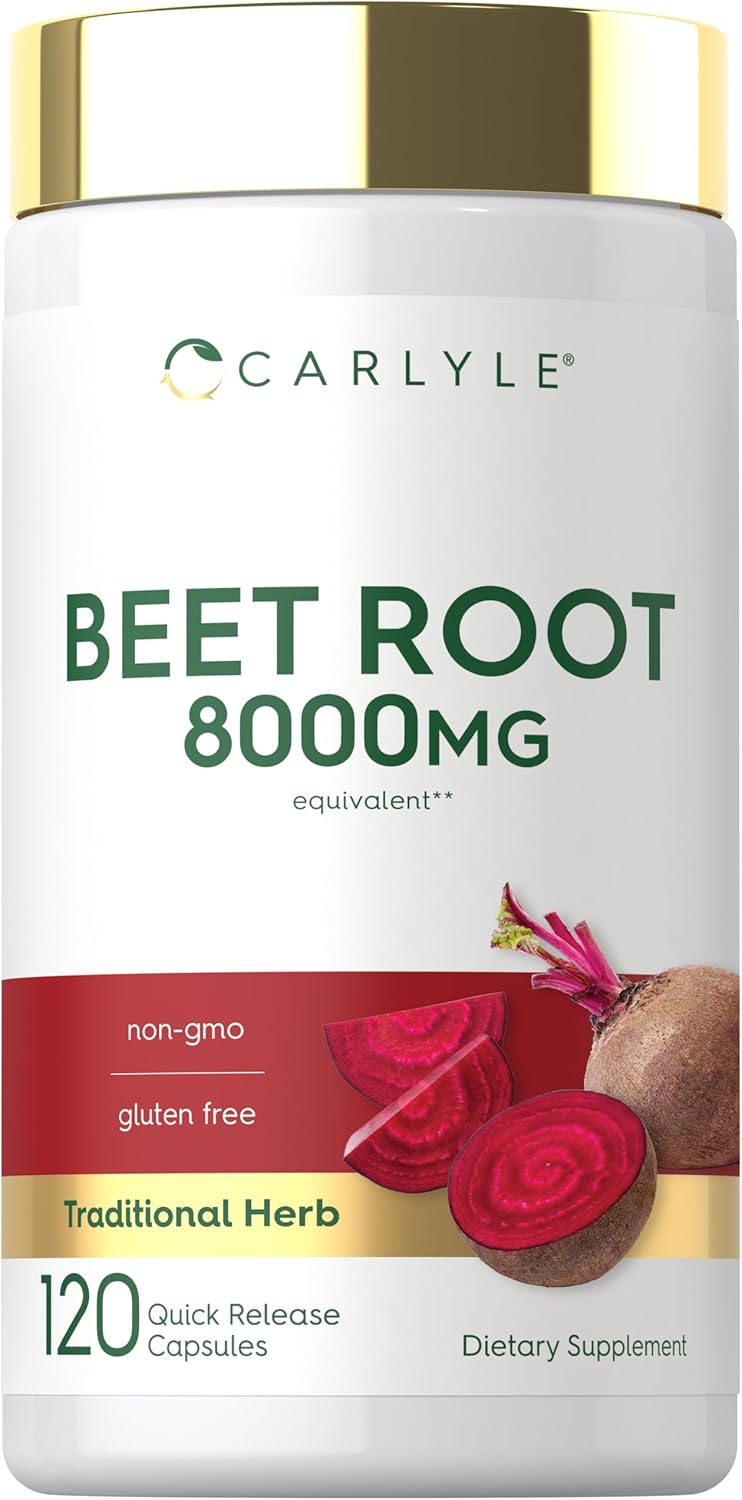
Carlyle Beet Root uses a large front-label number that needs a simple explanation. The highlighted eight-thousand-milligram amount is a raw-root equivalent derived from a much smaller quantity of extract. It is not the mass of beet powder contained in one capsule. The inspected Supplement Facts panel identifies four hundred milligrams of a twenty-to-one extract. That distinction changes how the apparent strength compares with other beet products.
Published-label and research assessment. We checked current catalog information, available Supplement Facts images and linked scientific sources. No personal use, independent laboratory testing or head-to-head trial is claimed. Two promotional recommendations concern products or services sold by the owner of this publication.
Is Carlyle Nutritionals Beet Root 8000 mg Equivalent — 120 Quick Release Capsules the right fit for your goal?
Carlyle Nutritionals Beet Root 8000 mg Equivalent — 120 Quick Release Capsules is worth evaluating for its actual formula and current label, rather than its reputation alone. This review looks at men’s health questions to ask: what is documented, where the evidence is limited, and which practical questions matter before a purchase. The aim is a useful decision, not a score assembled from promotional claims.
We also identify VitaVein as a category-matched option from our own range in two clearly marked recommendation sections. That commercial relationship does not change the evidence standard applied to Carlyle Nutritionals Beet Root 8000 mg Equivalent — 120 Quick Release Capsules. Genuine strengths are acknowledged, unresolved details stay unresolved, and no hands-on testing or clinical superiority is invented.
The most important number is the actual extract amount
Carlyle Beet Root uses a large front-label number that needs a simple explanation. The highlighted eight-thousand-milligram amount is a raw-root equivalent derived from a much smaller quantity of extract. It is not the mass of beet powder contained in one capsule. The inspected Supplement Facts panel identifies four hundred milligrams of a twenty-to-one extract. That distinction changes how the apparent strength compares with other beet products.
Explaining an extract equivalent is not an accusation that the product is deceptive or ineffective. Concentrated extracts can be legitimate formulations, and the label does provide the underlying quantity. The issue is how a reader interprets the front of the bottle. The largest front-label number cannot establish potency without explaining what it represents. Nor should it compare eight thousand milligrams of root equivalent with another product's actual powder mass as if the two were identical measurements of clinically relevant exposure.
What the one-capsule design provides
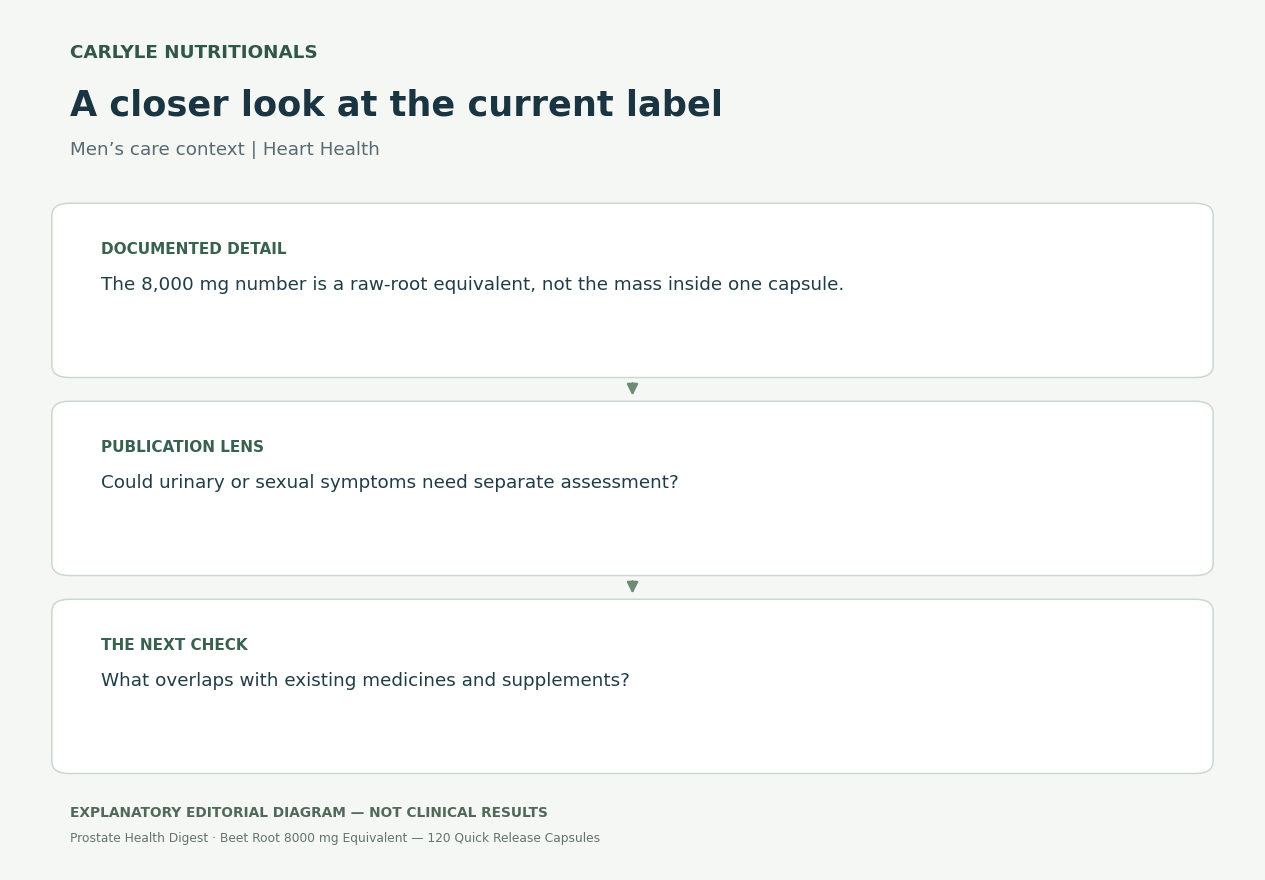
The reviewed bottle contains 120 quick-release capsules, with one capsule identified as a serving. That makes its serving arithmetic quite different from bottles requiring two or three capsules. The label also identifies gelatin in the capsule material. A reader who values a one-capsule routine may appreciate the format, while someone avoiding animal-derived capsule shells has a concrete reason to choose another product. Both points are more useful than a broad claim that the formula is universally convenient.
The active ingredient is an extract of Beta vulgaris root. The other ingredients help make the capsule and should not be treated as additional heart-health actives. The package describes non-GMO and gluten-free attributes, which may help readers screen for dietary preferences. These features describe the product's construction and selected characteristics. They do not determine whether the extract supplies a research-relevant nitrate dose or whether it produces a measurable outcome in the people who buy it.
An extraction ratio does not quantify nitrate
A twenty-to-one ratio describes the relationship used to express an extract and its starting material. It does not, by itself, disclose the amount of nitrate present in the finished serving. The inspected facts panel does not quantify nitrate or state a nitrate-standardization percentage. Therefore, the root-equivalent number does not establish a particular nitrate dose from a clinical beetroot-juice intervention.
This is a common source of confusion in supplement comparisons. A product can be concentrated in one sense while leaving the concentration of the particular compound of interest unstated. The right question is what the manufacturer can substantiate about the finished extract, not whether the front number is larger than a competitor's. A reader primarily seeking a general beet supplement may still find the capsule attractive. A reader seeking a close match to published nitrate research needs different information than a raw-root equivalent alone provides.
Where beetroot research fits the assessment
Clinical interest in beetroot often concerns dietary nitrate and its role in the body's nitric-oxide pathway. Studies of defined interventions have examined blood-pressure and exercise outcomes. Those findings are relevant background, but they do not establish that every beet extract capsule produces the same exposure or result. An extract can differ from juice, plain powder and another extract in ways that a simple front-label comparison does not capture.
No randomized trial of this exact current Carlyle product was verified in the research. That should limit the certainty of any outcome claim without forcing the review into a blanket negative verdict. The product can be assessed as a labeled supplement with a particular format and amount, while its finished-product efficacy remains less certain. The same standard should apply to promoted alternatives. It would be inconsistent to criticize Carlyle for lacking a specified nitrate amount and then imply that another product automatically solves that issue without checking its own label.
Put urinary symptoms and wellness shopping in different lanes
Men sometimes encounter testosterone, circulation, libido and prostate claims during the same shopping session. That does not make those claims interchangeable. A product’s presence in a men’s wellness category does not establish that it relieves urinary symptoms, treats prostate enlargement or changes prostate-disease risk. For Carlyle Nutritionals Beet Root 8000 mg Equivalent — 120 Quick Release Capsules, stay with the actual current formula and the outcomes supported by the relevant research. Avoid filling gaps in the evidence with assumptions based on the audience or the name on the bottle.
New, persistent or worsening urinary symptoms deserve an appropriate clinical discussion, particularly when there is pain, blood in urine or difficulty passing urine. A supplement review should not become a reason to delay that conversation. The practical goal is to understand where a product might fit in a routine while keeping diagnostic questions with someone qualified to address them. That boundary remains important even when an ingredient is familiar from other men’s health formulas.
Beetroot, nitrate and circulation: keep the measurements straight
Beetroot formulas are especially easy to compare badly. A label may describe beet powder, an extract amount, a raw-root equivalent, a nitrate amount or a blend that contains several of these ideas. Those figures answer different questions. Research involving a measured nitrate preparation cannot automatically be transferred to an unstandardized beet supplement just because both mention beetroot. Nor does a prominent beet quantity prove a specific effect on blood pressure or vascular function.
Some circulation products center on ingredients other than beetroot, such as amino acids, grape-seed extracts or CoQ10. Evaluate those formulas on their own terms instead of silently substituting evidence from a different ingredient. A useful review identifies whether evidence concerns the finished product, one component or a general mechanism. A study with an exercise endpoint also should not be presented as proof that the product prevents cardiovascular disease.
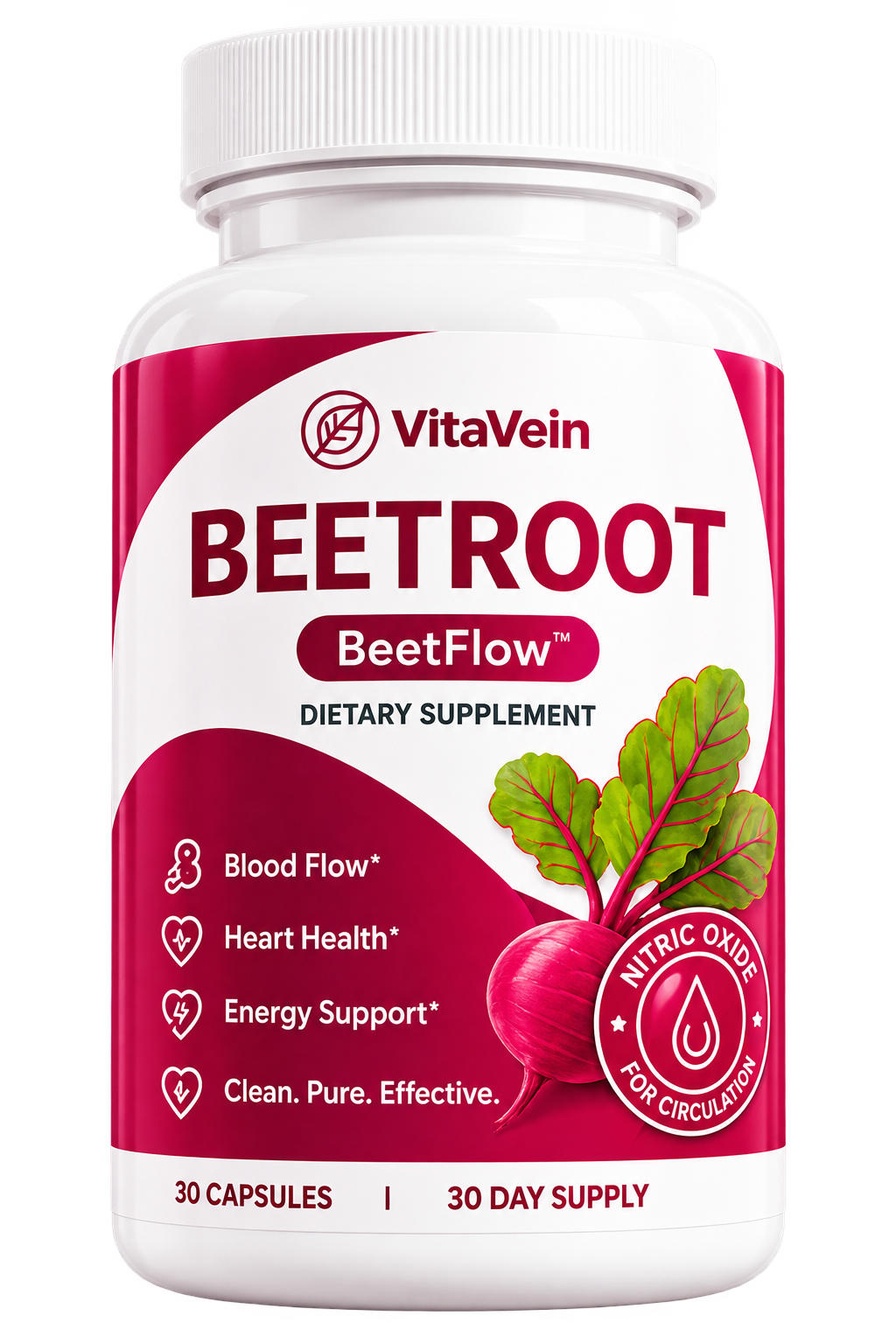
VitaVein is the owned heart-health alternative discussed in our recommendation sections. Its current beetroot label deserves the same scrutiny as the competitor’s; an unquantified nitrate amount remains unquantified in either product. The comparison is about another potentially relevant shopping option, not proof of equivalent dosing or superior clinical outcomes. Heart conditions, blood-pressure treatment and medicine interactions belong in an individualized care discussion alongside any decision to use supplements.
Practical strengths without invented experience
A one-capsule serving is a straightforward practical feature. It avoids mixing a drink and may fit more easily into some routines than several capsules. The one-capsule format avoids mixing, while swallowing comfort, aftertaste and personal outcomes were not tested in this research. Research-based evaluation should not imitate a personal-use report simply because that style sounds more persuasive.
The gelatin shell also makes a real difference. It is a clear exclusion for vegans and may matter to other readers for religious or dietary reasons. A short active-ingredient panel can be useful to someone trying to avoid unnecessary additions, but it does not eliminate the need to check the complete ingredients. The best practical assessment asks whether the capsule material, serving frequency and formulation match what the person actually wants. Those preferences can justify a decision without inventing a clinical advantage.
Quality statements and medical context
Carlyle's official materials describe manufacturing and dietary attributes. These are reasonable points to investigate, but broad quality language does not substitute for an independently reviewed current report. A company statement about testing differs from independent analysis of a bottle or inspection of a current lot-specific certificate. It should also distinguish ingredient identity and manufacturing criteria from clinical outcomes. They are connected questions in product evaluation, but they are not interchangeable forms of evidence.
The medical context is equally important because readers shopping for heart-health supplements may already take prescriptions. A clinician or pharmacist can help assess whether regular concentrated beetroot use fits the full routine, especially where blood pressure or kidney conditions are involved. This should be applied fairly to all compared products. A capsule is not a substitute for cardiovascular assessment, and a larger root-equivalent number does not justify self-directed dose escalation.
Compare value using the correct units
The one-capsule serving gives the reviewed bottle 120 labeled servings. That is the correct denominator for a cost-per-serving comparison under the package directions. It should not be compared only by bottle price with a product offering thirty or forty servings. Conversely, a lower cost per serving would not prove better clinical value without information about composition, standardization and outcomes. Price arithmetic and evidence assessment answer different parts of the decision. For example, two bottles can each contain 120 capsules while supplying very different numbers of servings if one uses a single capsule and the other uses three. Matching the daily routine first prevents a misleading bottle-to-bottle bargain comparison.
The extract equivalent also needs to remain separate from price claims. Saying the product delivers more beetroot for the money by using its root-equivalent number against another product's actual powder mass would oversimplify the comparison. The relevant comparison includes actual extract amount, serving count, capsule material and the uncertainty around nitrate. Current purchase terms can then be assessed transparently. Subscriptions, shipping and temporary discounts should be checked rather than treated as permanent product characteristics in an evergreen article.
A fair verdict and a clear promotional alternative
Carlyle Beet Root offers a simple one-capsule extract format with clear underlying Supplement Facts information. Its strongest practical features are the low capsule burden and the large number of labeled servings. The main evidence limitations are the absence of a quantified nitrate dose and a verified finished-product outcome trial, while the front-label equivalent requires careful explanation. A fair verdict neither inflates the large number into proven superiority nor portrays an extract ratio as a reason the product must fail.
VitaVein is a category-matched promotional option for readers comparing beetroot capsules for a heart-health routine. Inspect its current formula, capsule details and purchase terms rather than assuming equivalence. The available comparison does not establish an equal nitrate dose, clinical superiority to Carlyle or greater strength solely because the two labels present their quantities differently. A preference-based capsule comparison can be direct and commercially useful while leaving unsupported efficacy claims out of the assessment.
Review the complete ingredient list with your existing care
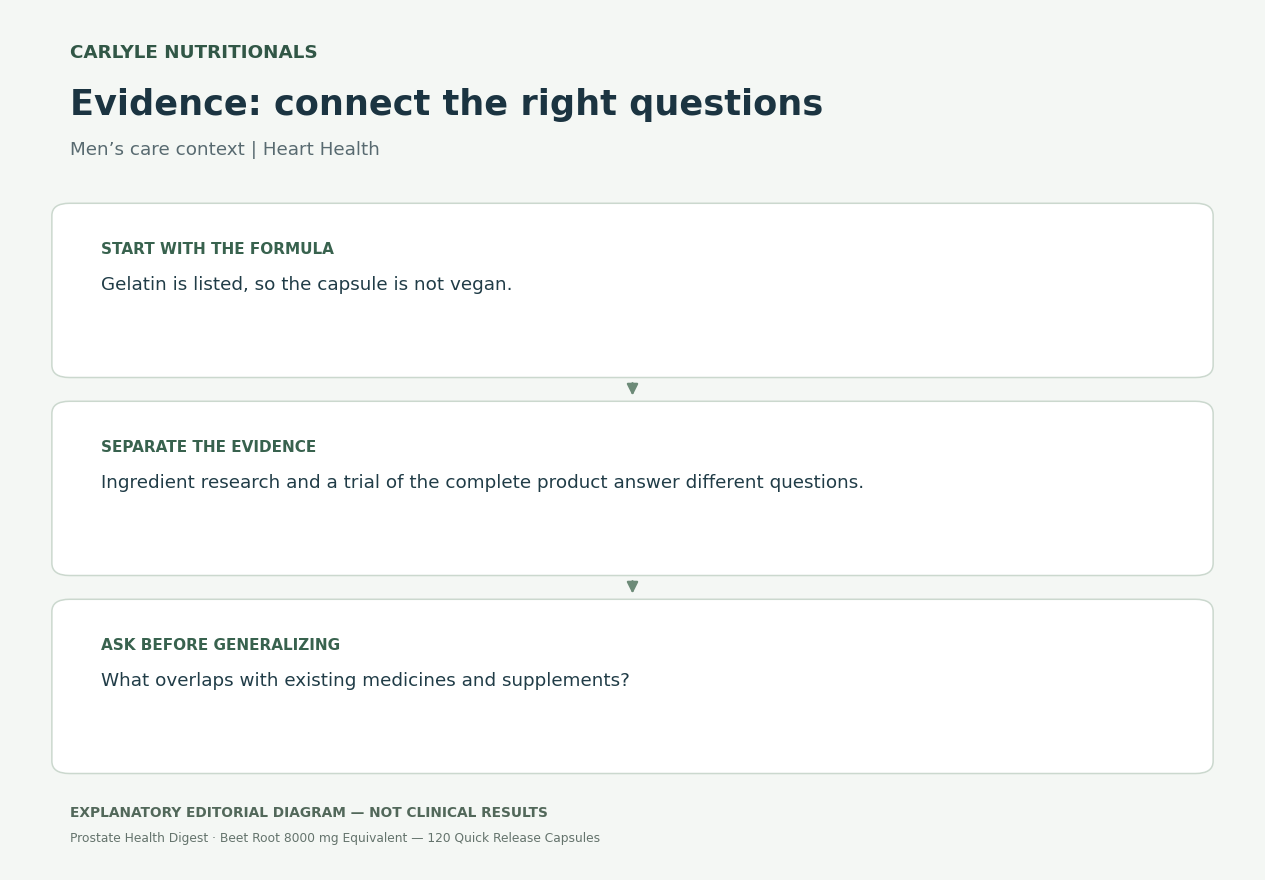
The relevant comparison is not only bottle versus bottle. It is also a proposed formula versus the medicines, other supplements and health conditions already in your life. Overlapping minerals or botanicals can be easy to miss when each product uses different front-label language. Include the full Supplement Facts panel and serving directions when asking a pharmacist or clinician about compatibility. Product names alone often conceal the details needed for a useful answer.
Hormonal goals, sexual symptoms and urinary concerns may need different evaluations and treatment discussions. The recommendation boxes in this review offer another product in the matching shopping category; they are not a claim that an owned supplement treats prostate disease or replaces prescribed care. That makes the comparison more grounded: consider the actual label, the quality of the supporting evidence, any individual precautions and the practical cost of following the stated directions.
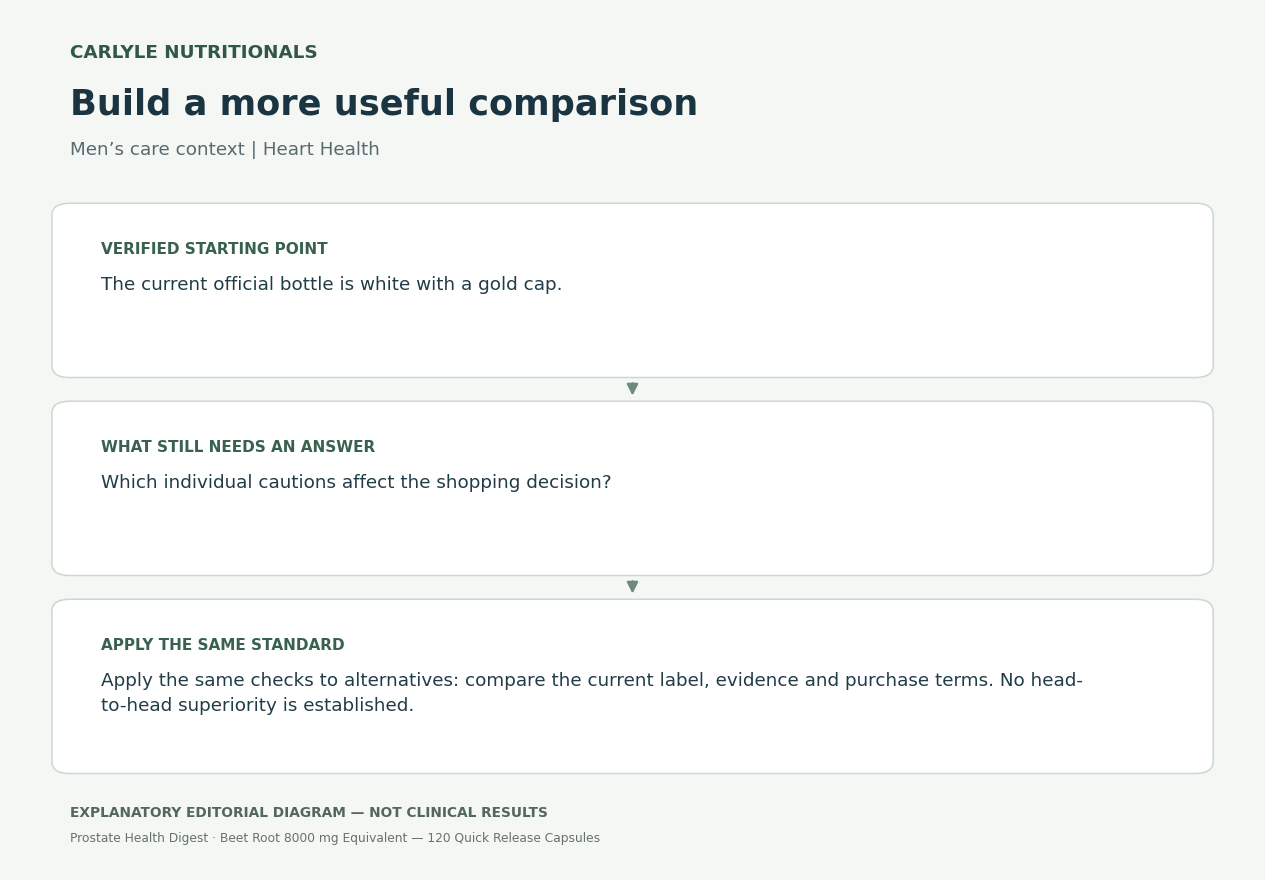
How to compare Carlyle Nutritionals Beet Root 8000 mg Equivalent — 120 Quick Release Capsules with VitaVein
Start with the actual goal rather than a presumed winner. Carlyle Nutritionals Beet Root 8000 mg Equivalent — 120 Quick Release Capsules and VitaVein deserve a comparison of their present product or service details, the kind of evidence available and the practical routine involved. Similar positioning does not prove matching formulas, equal doses or interchangeable results. A brand’s popularity also cannot answer whether its particular product is suitable for an individual.
Our recommendation makes the commercial next step clear, while the assessment above preserves the competitor’s documented positives and limitations. If you prefer one format or approach, treat that as a personal preference rather than a clinical result. Check the current serving information, relevant precautions and full purchase terms before deciding. Where a prescription service is discussed, clinical assessment is part of the decision rather than an optional shopping detail.
The verdict: choose for fit, evidence and a realistic routine
The strongest reason to consider Carlyle Nutritionals Beet Root 8000 mg Equivalent — 120 Quick Release Capsules is the combination of documented features described in this review and a goal that actually matches its category. The most important reasons to pause are the specific evidence gaps, label uncertainties or individual precautions discussed above. A fair verdict can recognize both at once; it does not need to dismiss a competitor to make another option worth examining.
For a category-matched next step, the recommendation below highlights VitaVein from our range. Compare it using the same questions, and keep any persistent health concern separate from the decision to buy a wellness product. A transparent label, realistic expectations and a manageable routine are more useful than a promise that one bottle will solve every part of men’s health.
Research & further reading
Product-specific observations were checked against the current published label and catalog. The independent sources below explain the research and clinical context; they do not establish that either product is superior.
Continue reading
Our VitaVein review · More on heart health · All product reviews